One wrong line in your knowledge base does more damage than a hundred missing ones
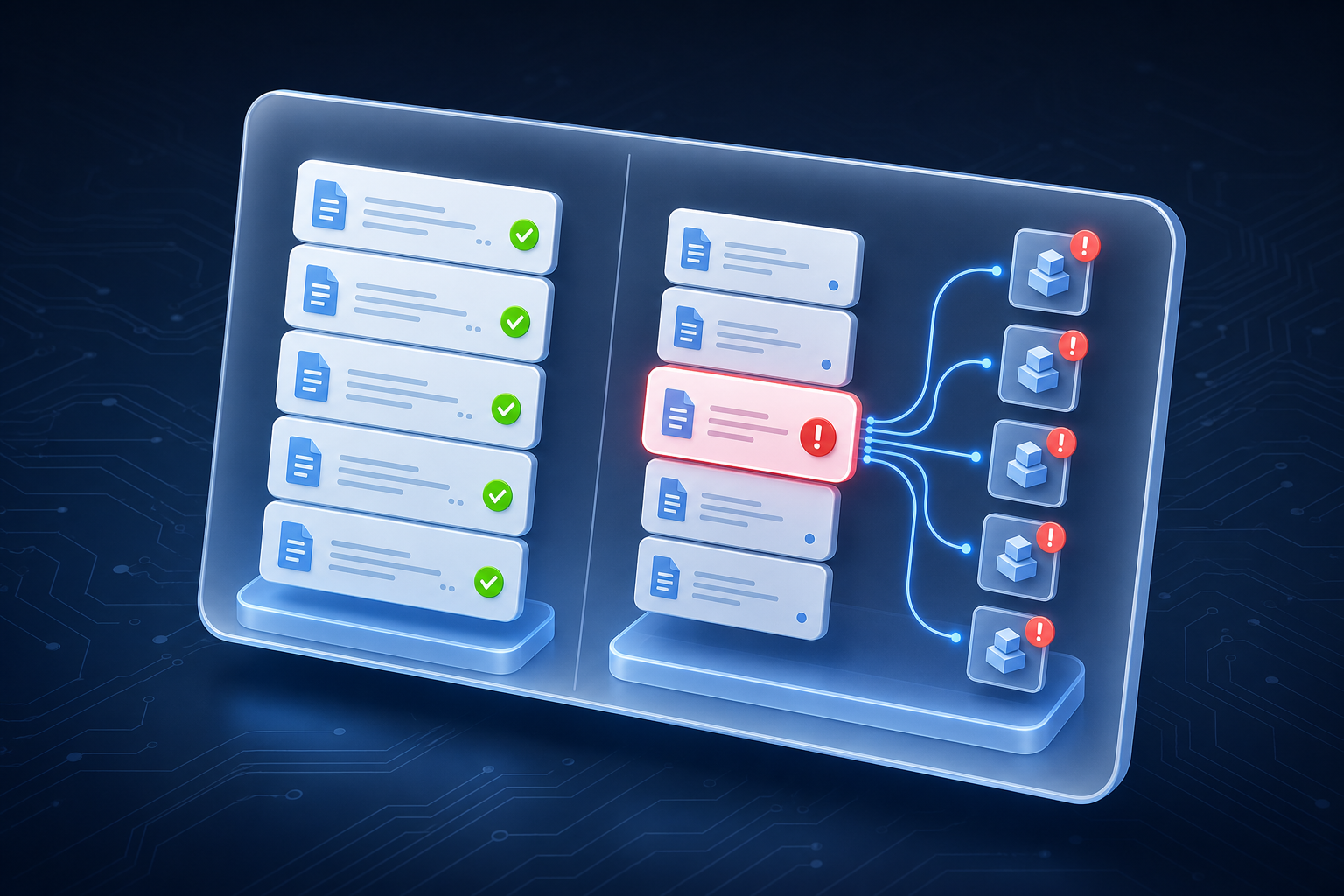
Give an AI assistant your documents and the first worry is always about gaps. The bigger risk is the line that is wrong.
A gap announces itself. A wrong line does not. It comes back in a calm, well-written sentence, and nobody can tell which document produced it.
The gap you can see and the error you cannot
Absence is visible and bounded. When the assistant has nothing to work from, it says it does not know. That is mildly annoying, and a person routes around it.
Error is invisible and compounding. An old price. A retired policy. A draft nobody approved. Any of these comes back with the same confidence as your best document, and the answer looks identical either way.
That is the asymmetry. One failure mode stops. The other spreads.
Three quotes went out wrong before anyone checked
I have sat with operators who found this the expensive way. A 14-person commercial contractor pointed an assistant at their shared drive to speed up quoting. The pricing sheet there carried one superseded labour rate, left behind after a rate change nobody finished cleaning up.
Three quotes went out at the old rate across two weeks. The assistant had no way to detect the problem. It read a document that looked approved and used it. The error surfaced only when a client queried a figure against an earlier job.
Rebuilding those quotes cost more than the pilot had saved.
Most knowledge bases have a search box and no gate
Look at where your documents actually sit. In most small businesses anyone can add a file, nothing carries a date, nothing carries a name, and drafts sit in the same folder as finals.
That holds up when humans read it, because humans hesitate. Someone opens a file, senses it is stale, and asks. An assistant does not hesitate. It reads everything with equal trust.
The fix is a gate, not a bigger library
The instinct is to add more. Feed it everything so it has full context. That makes it worse. Every document you add is another line that can be quoted back at you.
Put a gate in front instead. Every document the assistant can read carries four things: an owner by name, a date it was last checked, a status of draft, approved or retired, and a way to be pulled the same day.
A smaller approved set beats a larger mixed one every time.
When an answer is wrong, ask which document it came from
This is the habit that keeps the gate honest. When the assistant returns a bad answer, the first question is not about the tool. It is which document produced this.
That document then gets fixed or removed the same day, by its named owner. Not logged. Not queued for review.
Without this habit, the gate decays within a quarter.
Start with the fifty documents you would defend
Most owners scope a first knowledge project by counting what they have. Five hundred files exist, so five hundred files go in.
Scope it by what you would defend instead. The test is whether you would be comfortable seeing a document quoted to a client tomorrow, word for word, with nobody checking first. For most businesses that number lands closer to fifty.
Start with those. Add the rest once each one has a name and a date on it.
Keep exploring
If you want a second opinion on which documents are safe to point an assistant at, contact FIT. Your knowledge base is your governance layer goes deeper on ownership.